Reiseführer Innenstadt von Solo: 2026 das Beste in Innenstadt von Solo entdecken

Surakarta
At the museum no photos are allowed which is really unfortunate as it was well worth the visit and the guided tour is definitely not to be missed. In the museum there are even Batik made from the Dutch era which depicts stories like Little Red Riding Hood and Snow White!

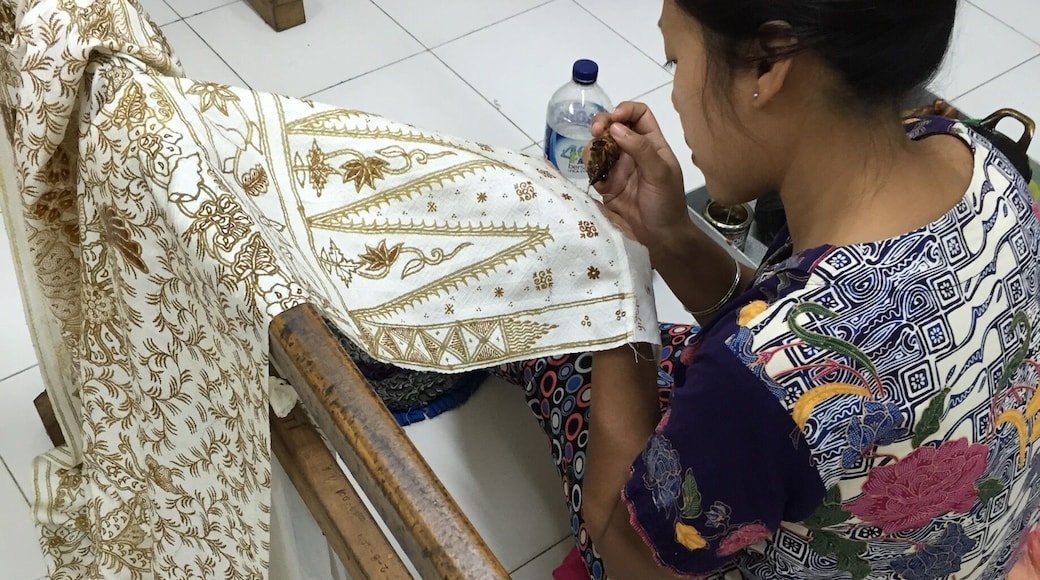
I enjoyed the tour v much and at the end of the tour we were brought to this room where the artisan were working on hand drawn batik.

Below is an excerpt from Wikipedia for anyone interested in learning more about the process of batik making.

Firstly, a cloth is washed, soaked and beaten with a large mallet. Patterns are drawn with pencil and later redrawn using hot wax, usually made from a mixture of paraffin or bees wax, sometimes mixed with plant resins, which functions as a dye-resist. The wax can be applied with a variety of tools. A pen-like instrument called a canting (IPA: [tʃantiŋ], sometimes spelled with old Dutch orthography tjanting) is the most common. A canting is made from a small copper reservoir with a spout on a wooden handle. The reservoir holds the resist which flows through the spout, creating dots and lines as it moves. For larger patterns, a stiff brush may be used. Alternatively, a copper block stamp called a cap (IPA: [tʃap]; old spelling tjap) is used to cover large areas more efficiently.

After the cloth is dry, the resist is removed by scraping or boiling the cloth. The areas treated with resist keep their original color; when the resist is removed the contrast between the dyed and undyed areas forms the pattern. This process is repeated as many times as the number of colors desired.

The most traditional type of batik, called batik tulis (written batik), is drawn using only the canting. The cloth need to be drawn on both sides and dipped in a dye bath three to four times. The whole process may take up to a year; it yields considerably finer patterns than stamped batik.

Source: Wikipedia
At the museum no photos are allowed which is really unfortunate as it was well worth the visit and the guided tour is definitely not to be missed. In the museum there are even Batik made from the Dutch era which depicts stories like Little Red Riding Hood and Snow White!

I enjoyed the tour v much and at the end of the tour we were brought to this room where the artisan were working on hand drawn batik.

Below is an excerpt from Wikipedia for anyone interested in learning more about the process of batik making.

Firstly, a cloth is washed, soaked and beaten with a large mallet. Patterns are drawn with pencil and later redrawn using hot wax, usually made from a mixture of paraffin or bees wax, sometimes mixed with plant resins, which functions as a dye-resist. The wax can be applied with a variety of tools. A pen-like instrument called a canting (IPA: [tʃantiŋ], sometimes spelled with old Dutch orthography tjanting) is the most common. A canting is made from a small copper reservoir with a spout on a wooden handle. The reservoir holds the resist which flows through the spout, creating dots and lines as it moves. For larger patterns, a stiff brush may be used. Alternatively, a copper block stamp called a cap (IPA: [tʃap]; old spelling tjap) is used to cover large areas more efficiently.

After the cloth is dry, the resist is removed by scraping or boiling the cloth. The areas treated with resist keep their original color; when the resist is removed the contrast between the dyed and undyed areas forms the pattern. This process is repeated as many times as the number of colors desired.

The most traditional type of batik, called batik tulis (written batik), is drawn using only the canting. The cloth need to be drawn on both sides and dipped in a dye bath three to four times. The whole process may take up to a year; it yields considerably finer patterns than stamped batik.

Source: Wikipedia

Beliebte Attraktionen


Top-Hotels in Innenstadt von Solo

The Royal Surakarta Heritage - Handwritten Collection

The Royal Surakarta Heritage - Handwritten Collection

5 out of 5
Jalan Slamet Riyadi No. 06 Surakarta Central Java
Der Preis beträgt 29 € pro Nacht vom 19. Jan. bis zum 20. Jan.
29 €
pro Nacht
19. Jan.–20. Jan.
Dieses Hotel im luxuriösen Stil bietet dir einen angenehmen Aufenthalt in Surakarta. Freu dich auf WLAN-Internetzugang (kostenlos), Parken ohne Service (kostenlos) ...
8,2/10 Very Good! (166 Bewertungen)
Lobby ist sehr schön. Fitnessraum vorhanden, aber eher heruntergekommen. Für die meisten Übungen jedoch in Ordnung. Frühstücksangebot ist gut. Pool mit schöner Aussicht. Jedoch war unser Zimmer ziemlich abgewohnt und auch nicht sauber. Daher die 2 abgezogenen Punkte.

Bewertet am 9. Juli 2024

The Royal Surakarta Heritage - Handwritten Collection
Novotel Solo

Novotel Solo

4 out of 5
Jalan Slamet Riyadi 272 Surakarta Central Java
Der Preis beträgt 28 € pro Nacht vom 1. Feb. bis zum 2. Feb.
28 €
pro Nacht
1. Feb.–2. Feb.
Dieses Hotel mit Wellnessangebot bietet dir einen angenehmen Aufenthalt in Surakarta. Freu dich auf WLAN-Internetzugang (kostenlos), Parken ohne Service (kostenlos) ...
8/10 Very Good! (113 Bewertungen)
Gutes Hotel, will mehr sein als es ist
super Frühstück, netter Pool, Zimmer gut, nicht mehr ganz neu

Bewertet am 6. Aug. 2018

Novotel Solo
ibis Styles Solo

ibis Styles Solo

3 out of 5
Jalan Gajah Mada 23 Surakarta Central Java
Der Preis beträgt 22 € pro Nacht vom 29. Jan. bis zum 30. Jan.
22 €
pro Nacht
29. Jan.–30. Jan.
Dieses Hotel mit Wellnessangebot bietet dir einen angenehmen Aufenthalt in Surakarta. Freu dich auf WLAN-Internetzugang (kostenlos), Parken ohne Service (kostenlos) ...
8/10 Very Good! (101 Bewertungen)
Our deluxe room was OK, clean and bright although some black spots on the walls could be seen. Also horrible noise that disturbed us was loud music from the bar of the Novotel Hotel which started from 10.00 pm to 2 am every night. We informed the Ibis staffs about the noise, but no changes.

Bewertet am 11. Juli 2019

ibis Styles Solo
GRAND ORCHID HOTEL SOLO

GRAND ORCHID HOTEL SOLO

3 out of 5
Jl. Gajahmada No.29, Timuran, Surakarta Central Java
Der Preis beträgt 19 € pro Nacht vom 15. Jan. bis zum 16. Jan.
19 €
pro Nacht
15. Jan.–16. Jan.
Dieses Hotel für Geschäftsreisende bietet dir einen angenehmen Aufenthalt in Surakarta. Freu dich auf Parken ohne Service (kostenlos), Frühstück (gegen Gebühr) ...
GRAND ORCHID HOTEL SOLO
FIM by Zigna

FIM by Zigna

3 out of 5
31 Jl. Yosodipuro Surakarta Jawa Tengah
Dieses Hotel mit Wellnessangebot bietet dir einen angenehmen Aufenthalt in Surakarta. Freu dich auf WLAN-Internetzugang (kostenlos), Parken ohne Service (kostenlos) ...
9,4/10 Exceptional! (6 Bewertungen)
The hotel is an excellent place to stay. The hotel itself is not special or fancy, but it is well-run, clean, and located in the center of Solo. The breakfast buffet is excellent, the restaurant is good, and the hotel also has a nice cafe with an outside seating area. They featured life music at ...

Bewertet am 19. Juli 2025

FIM by Zigna
Front One Budget Hotel Slamet Riyadi Solo

Front One Budget Hotel Slamet Riyadi Solo

2 out of 5
110 Jl. Slamet Riyadi Surakarta Jawa Tengah
Dieses Hotel bietet dir einen angenehmen Aufenthalt in Surakarta. Freu dich auf WLAN-Internetzugang (kostenlos), eine rund um die Uhr besetzte Rezeption und ...
Front One Budget Hotel Slamet Riyadi Solo
Dies ist der niedrigste Preis pro Nacht für 1 Übernachtung von 2 Erwachsenen, der in den letzten 24 Stunden gefunden wurde. Preise und Verfügbarkeiten können sich ändern. Es können zusätzliche Bedingungen gelten.

Weitere Gegenden von Innenstadt von Solo

At the museum no photos are allowed which is really unfortunate as it was well worth the visit and the guided tour is definitely not to be missed. In the museum there are even Batik made from the Dutch era which depicts stories like Little Red Riding Hood and Snow White!

I enjoyed the tour v much and at the end of the tour we were brought to this room where the artisan were working on hand drawn batik.

Below is an excerpt from Wikipedia for anyone interested in learning more about the process of batik making.

Firstly, a cloth is washed, soaked and beaten with a large mallet. Patterns are drawn with pencil and later redrawn using hot wax, usually made from a mixture of paraffin or bees wax, sometimes mixed with plant resins, which functions as a dye-resist. The wax can be applied with a variety of tools. A pen-like instrument called a canting (IPA: [tʃantiŋ], sometimes spelled with old Dutch orthography tjanting) is the most common. A canting is made from a small copper reservoir with a spout on a wooden handle. The reservoir holds the resist which flows through the spout, creating dots and lines as it moves. For larger patterns, a stiff brush may be used. Alternatively, a copper block stamp called a cap (IPA: [tʃap]; old spelling tjap) is used to cover large areas more efficiently.

After the cloth is dry, the resist is removed by scraping or boiling the cloth. The areas treated with resist keep their original color; when the resist is removed the contrast between the dyed and undyed areas forms the pattern. This process is repeated as many times as the number of colors desired.

The most traditional type of batik, called batik tulis

Banjarsari

Während deines Besuchs in Banjarsari solltest du Sehenswürdigkeiten wie Solo Paragon Lifestyle Mall und Balekambang-Park einen Besuch abstatten.

Banjarsari


Reiseführer Innenstadt von Solo: 2026 das Beste in Innenstadt von Solo entdecken

Wähle zwei oder mehr Produkte aus, um bei deiner Reise zu sparen: